Table of Contents

What is Volume LTL and When to Use It
Published Date: 09 September 2026
Volume LTL (less-than-truckload) is a freight method for shipments of six to 24 pallets, too large for standard LTL but too small for a full truckload. Beverage shippers use it to fill unused trailer space and cut costs on flexible-timeline shipments.
Volume LTL freight is a shipping method for loads that fall between standard less-than-truckload (LTL) and full-truckload (FTL) shipments. If your last shipment was too large for standard LTL but not quite large enough for a full truckload, volume LTL shipping might be the answer.
At Brew Movers, we help beverage shippers choose the right method every time, whether that’s standard LTL, volume LTL, or full-truckload. We’re just the right people to help you pick your freight method.
What is Volume LTL Shipping?
Volume less-than-truckload, often abbreviated as volume LTL or VLTL, is a freight method designed for mid-sized shipments. Volume LTL shipments typically weigh at least 5,000 pounds and range from six to 24 pallets, occupying roughly 12 to 32 linear feet of trailer space, though exact minimums vary by carrier.
For breweries, wineries, distilleries, and beverage brands moving cans, kegs, tanks, or bulk ingredients, that middle ground comes up constantly.
How Does Volume LTL Work?
Traditional LTL freight networks run on efficiency. LTL carriers pick up shipments from multiple shippers, consolidate everything at a hub, then sort and redeliver based on destination. Even the most efficient carrier networks end up with partially empty trailers along the way.
Volume LTL shipping fills those gaps. Your freight moves into unused trailer space that would otherwise go to waste, which is a big part of why volume LTL is usually cheaper than traditional LTL shipping.
Unlike standard LTL, which prices by freight class, volume LTL pricing is based on linear footage, density, and total weight, so accurate dimensions matter for volume LTL quotes. Strict dimensional limits apply, and exceeding them can trigger reclassification fees.
Volume LTL vs Standard LTL Shipping
Standard LTL shipments typically move through multiple hubs, getting unloaded and reloaded as they travel toward their final destination. That extra handling adds transit time and increases the risk of damage.
Volume LTL freight usually stays on one trailer for the length of the trip, which means less handling and a lower risk of damage. That matters when shipping fragile equipment, glass bottles, or full kegs.
The tradeoff is scheduling. Volume LTL shipping depends on available space on other shipments, so transit times can be slower and more variable than for full truckload shipments, which ship straight through.
If your load is not time-sensitive, that tradeoff is often worth the cost savings.
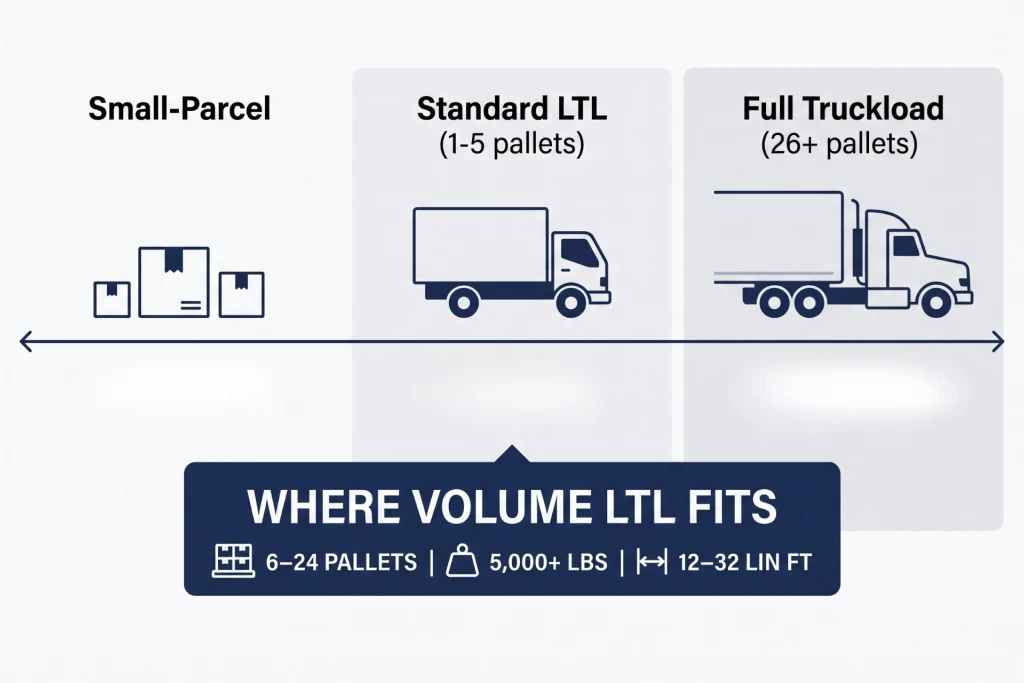
Image Source: Gemini 2026
Volume LTL vs. Partial Truckload
Volume LTL and partial truckload are sometimes used interchangeably, but they run on different networks.
Volume LTL uses the LTL carrier network and standard LTL shipping’s freight class system, while partial truckload uses the truckload freight network at market rates.
Partial truckload shipments ship straight through with more predictable delivery, while volume LTL freight moves at the carrier’s convenience once trailer space opens up.
When Should You Use Volume LTL Freight?
Volume LTL shipping is a strong fit when:
- Your shipment falls in that middle ground. Six or more pallets, but not enough to fill an entire truck, is the sweet spot for volume LTL freight.
- Your delivery window has some flexibility. Volume LTL shipments move at the carrier’s convenience, so this shipping method works best when you’re not racing a hard deadline.
- You’re shipping lower-value cargo. Volume LTL carries a lower liability limit than standard LTL shipping, so it’s not the right shipping option for your most valuable or irreplaceable freight.
- You want to cut shipping costs on equipment or ingredients. Tanks, kegs, packaging, and dry ingredients are among the most common LTL shipping volume categories in the beverage industry.
Preparing for Volume LTL Shipments
Volume LTL shipments require a complete bill of lading, accurate labeling, and proper packaging before pickup, since freight changes hands across a vast network of carriers en route.
That paperwork multiplies fast for beverage shippers. Between coordinating multiple LTL carriers, shifting trailer capacity, and the extra requirements tied to shipping alcoholic beverages across state and provincial lines, the red tape can pile up fast.
This is where Brew Movers earns its keep: a dedicated beverage logistics partner handles the paperwork and carrier coordination so you can focus on production.
Why Volume LTL Makes Sense for Beverage Shippers
Volume LTL gives beverage companies a cost-effective way to ship loads that fall in between small-parcel and full-truckload, without paying for space they don’t need.
That in-between gap comes up constantly in the beverage industry: a new brewery ordering kegs and packaging, an established distillery restocking bulk ingredients between production runs, a kombucha brand sending finished product to a handful of new retail accounts.
None of those shipments fit neatly into small-parcel or full-truckload categories, which is exactly the gap volume LTL is built to fill.
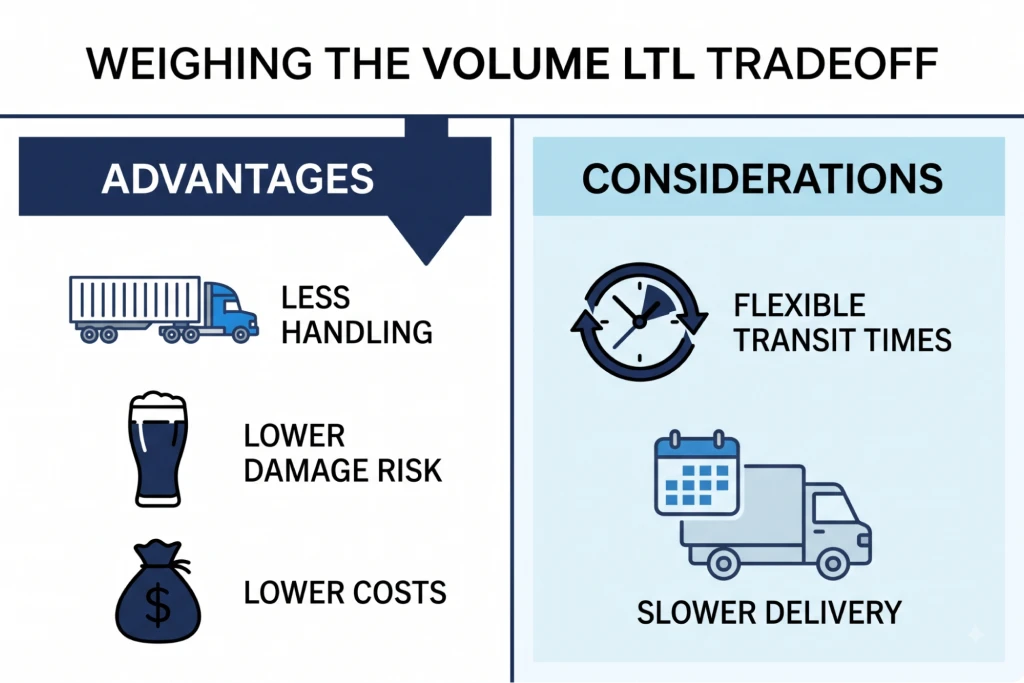
Image Source: Gemini 2026