Table of Contents
- What Do FDA Beverage Regulations Cover?
- FDA Requirements for Beverage Labels
- FDA Alcoholic Beverage Regulations: Where the FDA Ends and the TTB Begins
- FDA Labeling Requirements for Imported Beverages
- Are CBD Beverages FDA Compliant?
- FDA Regulations for Starting a Beverage Business: Labeling Compliance Checklist
- Key Takeaways
- Keep Compliant Product Moving

FDA Beverage Regulations: A Guide for Beverage Brands
Published Date: 11 November 2026
Food and Drug Administration (FDA) beverage regulations treat most nonalcoholic drinks as food. Brands need a registered facility, safe ingredients, and labels with nutrition facts and major allergens. Most beer, wine, and spirits fall under the Alcohol and Tobacco Tax and Trade Bureau (TTB) instead.
A pallet of kombucha can leave the brewery on time and still sit at the border because nobody filed the FDA’s import notice. A missing allergen line on the label can stall it just as fast, and so can an expired facility registration, with this year’s renewals due by December 31, 2026.
That kind of paperwork is where most beverage shipments get stuck. Brew Movers brings more than two decades of logistics experience to the beverage industry, and our team handles beverage logistics across North America.
A big part of the job is clearing that red tape before a truck gets booked. Here’s what FDA beverage regulations require and where you need to stay ahead of them.
What Do FDA Beverage Regulations Cover?
FDA beverage regulations cover the ingredients, production facilities, and labels of nonalcoholic drinks and some alcoholic ones. The FDA treats these drinks as food under the Federal Food, Drug, and Cosmetic Act (FD&C Act), the same law that covers the rest of the US food supply.
- Ingredient safety. Every ingredient must be an approved food additive or Generally Recognized as Safe (GRAS), and colors must be approved color additives.
- Food safety practices. Current Good Manufacturing Practices (CGMPs) are the ground rules food companies follow for clean equipment and consistent batches. Under the Food Safety Modernization Act (FSMA), most facilities also need a written food safety plan.
Using a co-packer doesn’t change any of this. FDA regulation of food and beverage products follows your brand, and your name is the one on the can. Our post on regulatory compliance in the beverage industry covers the state licensing side.
FDA Food Facility Registration
Food facilities that manufacture, prepare, pack or hold beverages for US customers must register with the FDA, including sites outside the country. Registrations must be renewed every even-numbered year between October 1 and December 31, so every facility is due by December 31, 2026, no matter when it first registered.
Let yours expire and imports can be turned back at the border. Our guide on FDA food facility registration for beverage producers covers everything you need to renew your registration.
FDA Requirements for Beverage Labels
FDA requirements for beverage labels include five core elements: the product’s common name, net quantity, ingredient list, manufacturer name and address, and a Nutrition Facts panel, plus any major allergens.
All required label information has to be in English, and most required text must be at least 1/16 inch tall.
- Nutrition Facts Label. The current panel lists total sugars and added sugars on separate lines, along with vitamin D.
- Juice percentage. If a drink contains juice or suggests it does, the label has to state the total percentage.
Marketing claims need care too. Nutrient content claims like “low sugar” and health claims like “supports heart health” must meet FDA definitions. Get labels right at the proof stage, since relabeling a full truckload in a warehouse costs far more.
FDA Allergen Labeling Requirements for Beverages
FDA allergen labeling requirements for beverages cover nine major food allergens: milk, eggs, fish, crustaceans, tree nuts, peanuts, wheat, soybeans, and sesame. If your drink contains any of them, the label must list them in the ingredient list or in a separate “Contains” statement.
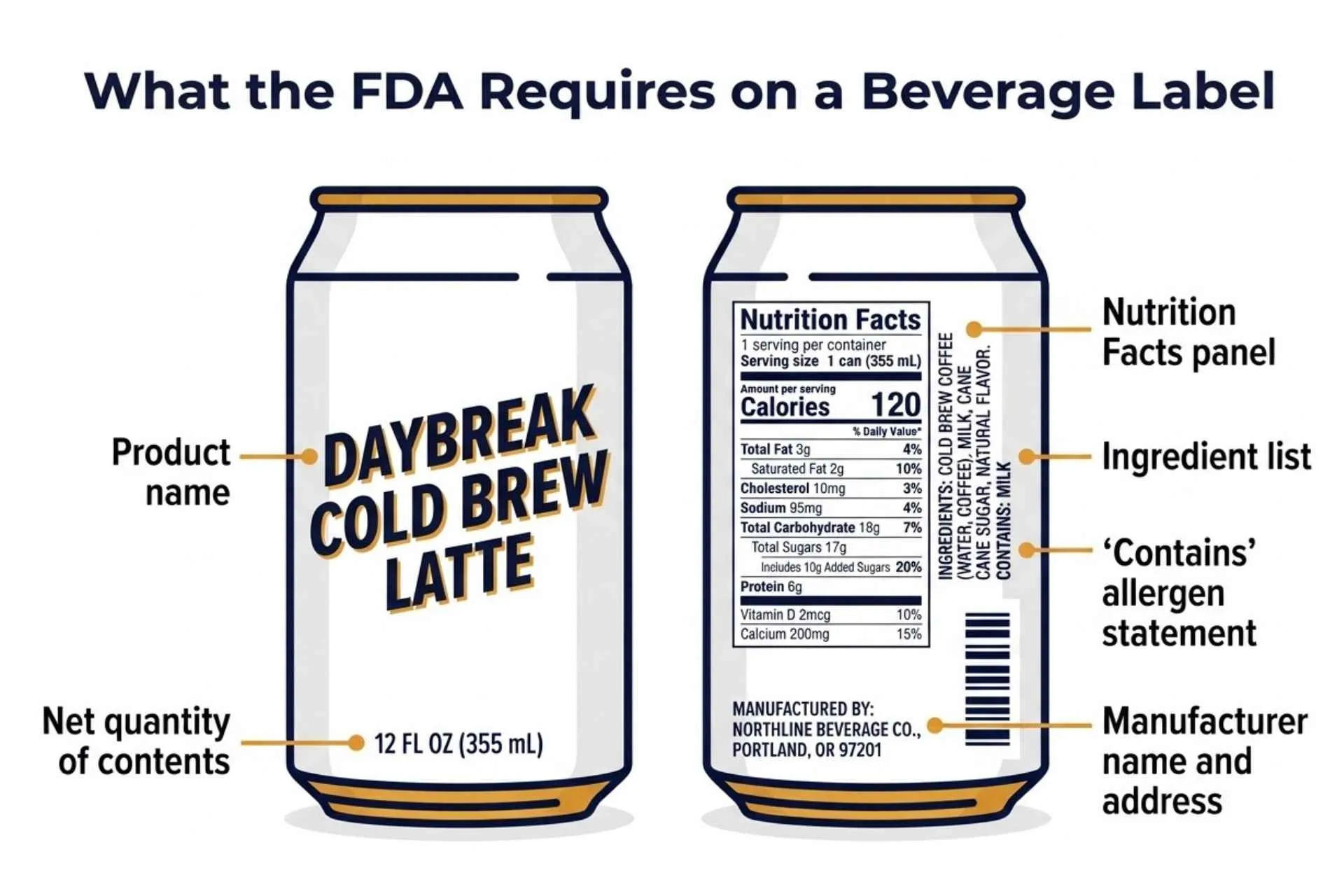
Image Source: Gemini 2026
FDA Alcoholic Beverage Regulations: Where the FDA Ends and the TTB Begins
FDA alcoholic beverage regulations cover drinks that fall outside the TTB’s definitions, such as low-alcohol wine and sorghum beer. The TTB regulates most other beer, wine, and spirits.
| Regulated by the FDA | Regulated by the TTB |
| Wine and cider under 7% ABV | Wine and cider at 7% ABV and up |
| Beer made without both malted barley and hops | Malt beverages (most beer) |
| Sugar-based (non-malt) hard seltzers under 7% ABV | Distilled spirits |
A sorghum beer and a barley lager can sit on the same shelf and answer to different agencies.
Under FDA alcohol guidelines, these drinks carry a standard food label, and FDA alcohol labeling covers the Nutrition Facts panel and any major allergens. They still need the federal Government Warning statement, though.
The Alcoholic Beverage Labeling Act requires it on every alcoholic beverage at 0.5% ABV or higher, including the ones the FDA regulates. The FDA doesn’t pre-approve labels either, so getting them right is on you.
TTB products don’t work like that. Before they can be sold in interstate commerce, they need a Certificate of Label Approval (COLA). The TTB also proposed mandatory allergen labeling in January 2025, but at the time of writing, the rule was not final.
Labels are just one part of shipping alcohol. If your shipments cross state lines, permits and carrier rules come into play, and that’s the red tape Brew Movers handles for clients.
FDA Labeling Requirements for Imported Beverages
FDA labeling requirements for imported beverages are the same as for domestic drinks, and all required text must be in English. Imported foods also require a country-of-origin label under US customs law.
- Prior Notice. The FDA requires this advance alert before any food shipment arrives.
- Facility registration. The foreign manufacturer needs a current FDA food facility registration.
- Supplier checks. Importers of nonalcoholic beverages must verify their suppliers meet US food safety regulations under the Foreign Supplier Verification Program (FSVP).
Miss one and you’re looking at import refusals. If you ship from Canada or Mexico, build Prior Notice into your booking timeline, since the filing requires carrier details and must be submitted before the truck reaches the border.
Image Source: Canva
Are CBD Beverages FDA Compliant?
Cannabidiol (CBD) beverages are not FDA-compliant. Since 2019, the FDA has said that adding CBD to food or drinks violates federal law. The only CBD product it has approved is Epidiolex, a prescription drug.
A new legal definition of hemp goes into effect December 11, 2026, which limits finished products to 0.4 milligrams of total tetrahydrocannabinol (THC) per container. A hemp THC seltzer with five milligrams per can would be more than 12 times over that limit.
The cap reaches CBD drinks too. Full-spectrum CBD contains trace amounts of THC, so even a non-intoxicating drink can test over 0.4 milligrams per container.
Shipping hemp drinks now? Plan for inventory you may not be able to move after that date. Our guide to shipping hemp-derived products covers the carrier and state rules.
FDA Regulations for Starting a Beverage Business: Labeling Compliance Checklist
New beverage brands should check their ingredients, facility registration, and labels against FDA rules before the first production run. We cover the business side in our guide to starting a beverage company.
Rules change often, so confirm specifics with the FDA, TTB, or a regulatory consultant before launch.
- Determine if the FDA or the TTB has jurisdiction over your product.
- Check every ingredient and color additive for approved or GRAS status.
- Renew your facility registration by December 31, 2026, or confirm your co-packer has.
- Review product labels for the five required elements and any allergens.
- File Prior Notice before every imported shipment.
- Confirm your carriers follow the FDA’s Sanitary Transportation rule for temperature control and clean equipment.
FAQs About FDA Beverage Regulations