Table of Contents
- Why Direct-to-Consumer Shipping Matters for Craft Beer
- Major Legislative Shifts for DTC Alcohol Shipping (2025–2026)
- The 2026 Direct Shipping Map: Where Can You Ship Beer DTC?
- Common Carrier Rules for 2026
- New Tax and Compliance Hurdles in 2026
- DTC Wine Shipping vs. Beer and Hard Seltzer
- Protecting Your Product: Cold Chain and Pallet Parka
- FAQs About Shipping Directly to Consumers
- Key Takeaways
- How Brew Movers Simplifies the Red Tape

DTC Beer Shipping Laws by State: What’s Changed in 2026
Published Date: 06 May 2026
Navigating direct-to-consumer beer shipping in 2026 requires staying ahead of shifting state laws. This guide breaks down the latest legislative changes, tax obligations, and compliance hurdles for breweries looking to master their DTC beer shipping strategy.
Navigating the world of direct-to-consumer shipping often feels like trying to brew a perfect IPA while blindfolded. You know the ingredients, but the environment is constantly shifting.
As we move into 2026, the landscape of DTC beer shipping has become even more complex. While wine has enjoyed broad shipping privileges for years, beer continues to fight an uphill battle against antiquated state laws and the intricacies of the three-tier system.
At Brew Movers, we specialize in helping craft brewers manage the red tape and logistical headaches of transporting alcoholic beverages. Whether you’re a small out-of-state brewery or a large-scale producer of soda and kombucha, we’re here to help you understand the current state of direct-to-consumer beer shipping so you can focus on growth this calendar year.
Why Direct-to-Consumer Shipping Matters for Craft Beer
For many breweries, the ability to sell directly to consumers is the difference between stagnation and growth. While retailers and off-premises networks are vital, DTC sales enable a brand to build a personal connection with its customers.
In 2026, direct-to-consumer (DTC) models will no longer be just a trend, but a necessity for craft beer survival.
Major Legislative Shifts for DTC Alcohol Shipping (2025–2026)
The last 18 months have seen significant movement in state capitals across North America. Here’s a breakdown of the most critical updates brewery owners need to know.
Arkansas: The On-Site Barrier Is Gone
For years, Arkansas was a “visit first” state, meaning a consumer had to physically visit wineries before sending shipments to their home. However, legislation passed in mid-2025 (H 1476) officially removed this requirement.
As of August 2025, out-of-state wine producers can apply for DTC permits without consumers needing to set foot in their wineries. While it’s only applicable to wines for now, beer could be on the horizon soon. It’s still a massive win for national brand discovery.
California: The Spirits Influence
California recently updated its distilled spirits shipping rules through AB 1246. While this focuses on spirits, it’s important for brewery owners to keep an eye on it. The bill now allows out-of-state distillers to sell directly to consumers, but includes a sunset clause that expires on December 31, 2026.
Other states are watching this “pilot” approach to shipping as a potential model for expanding beer and spirit access in the future.
Mississippi: A Cracked Door
Mississippi long held a reputation as one of the strictest states for alcohol logistics. In July 2025, the state introduced the Direct Wine Shipper Permit, finally opening its doors to DTC wine shipping.
While this has not yet fully extended to beer, it has established the licensing infrastructure that many industry advocates expect will be leveraged for beer in the coming years. Keep an eye on this state; if you’re already licensed for wine, you’re ahead of the curve.
The Rhode Island Nuance: A Case Study in Complexity
In Rhode Island, consumer shipping rules are particularly strict. For Rhode Island residents, the law traditionally required an on-site purchase before a shipment could be sent.
This “visit first” rule is one of the most common hurdles for direct shippers. If you’re looking to ship DTC to this state, you must ensure your licensing requirements are fully met to avoid heavy fines.
Delaware: The “Unworkable” Law
In a classic case of one step forward and two steps back, Delaware passed a wine DTC bill (HB 187) in late 2025 that many carriers and producers have deemed unworkable. The law includes high permit fees and strict volume caps, making it financially difficult for smaller craft producers to enter the market.
Most major carriers remain cautious about shipping to Delaware residents until a “fix bill” is passed.
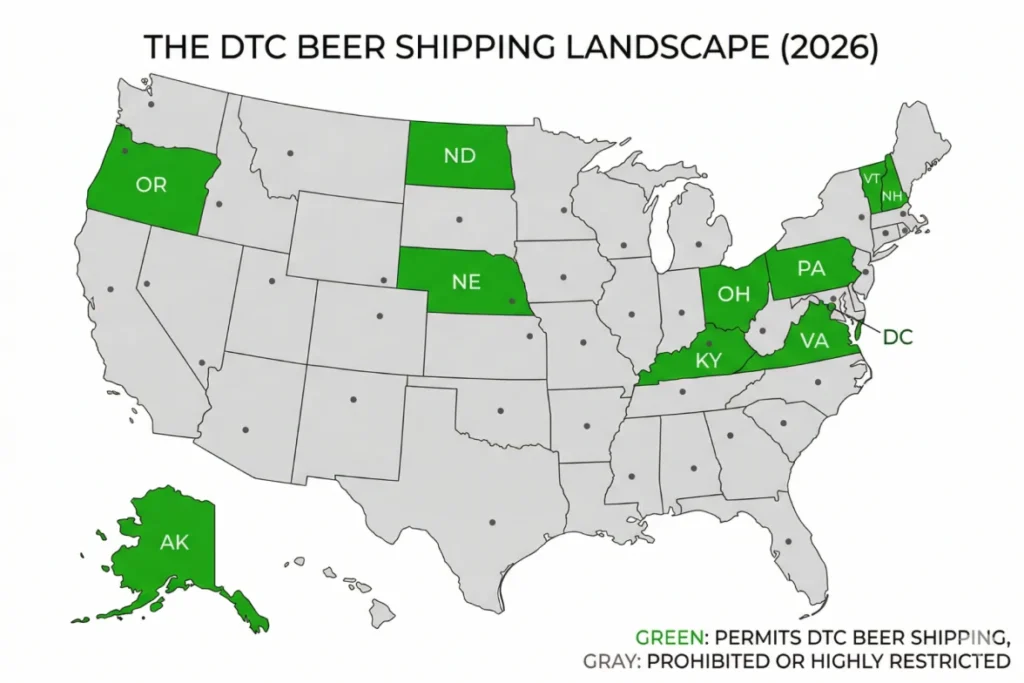
Image Source: Gemini 2026
The 2026 Direct Shipping Map: Where Can You Ship Beer DTC?
As of April 2026, the number of states allowing out-of-state breweries to ship beer directly to residents remains relatively small compared to the wine industry. Currently, only 10 states and the District of Columbia (DC) permit interstate DTC beer shipping.
| State | DTC Beer Shipping Requirement |
| Alaska | Requires a manufacturer’s direct shipment license |
| District of Columbia | No specific DTC license is required, but there is a limit of one case per month |
| Kentucky | Shippers must hold a direct shipper Type A license |
| Nebraska | Requires a retail direct sales shipping license or equivalent; limited to 108 liters per individual per year |
| New Hampshire | Requires a direct shipper permit and caps shipments at 27 gallons of beer per year |
| North Dakota | Requires a Direct Shipping License |
| Ohio | Requires an S-1 (Type S) shipper permit |
| Oregon | Requires a direct shipper permit; has a monthly limit of nine liters per case (18 liters per individual) |
| Pennsylvania | Requires a malt or brewed beverage shipper license; has a monthly limit of 192 ounces |
| Vermont | Requires an in-state or out-of-state consumer shipping license |
| Virginia | Requires a beer shipper’s license; has a monthly limit of two cases of wine or beer |
Common Carrier Rules for 2026
You cannot simply drop a shipment of craft beer at a standard post office. You must use an approved common carrier, such as UPS or FedEx.
These direct shippers have strict protocols, including mandatory adult signature (21+) upon delivery and clearly labeled packages.
Learn more: Complete Guide to Transporting Alcohol Across State Lines
Some counties within states like Virginia or Pennsylvania still prohibit the purchase or delivery of alcohol. As a DTC beer shipper, make sure to verify that the destination address is not in one of these zones. |
New Tax and Compliance Hurdles in 2026
DTC shipping isn’t just about where you can ship; it also covers how you report it. Several states have introduced new administrative burdens this year.
| State or City | Update Type | Effective Date | Details |
| Chicago, IL | New Liquor Tax | March 1, 2026 | Additional 1.5% tax on all liquor sold at retail stores |
| Illinois | Licensing Portal | Feb 11, 2026 | All alcohol licensing moved to the mandatory Licensing and Compliance Portal from the ILCC (Illinois Liquor Control Commission) |
| Maine | Bottle Deposits | July 1, 2025 | DTC bottles are now part of the state bottle deposit law. |
| Iowa | Reporting System | Nov 3, 2025 | Transitioned to the GovConnectIowa portal for all licensing and reporting. |
What are DTC Sales Tax Obligations in 2026?
One of the biggest headaches for DTC shippers is the sales tax.
Every state has different sales tax obligations that must be tracked based on where the beer is shipped directly. In multiple states, you’re required to collect tax based on the destination zip code, which can be a nightmare for craft brewers without automated systems.
What is the Excise Tax Burden?
Beyond sales tax, direct-to-consumer beer shipping triggers excise tax.
Unlike other products, alcoholic beverages are taxed at both the federal and state levels. As an out-of-state brewery, you’re responsible for filing these reports accurately to maintain your manufacturer-direct shipment license.
Image Source: Pexels
DTC Wine Shipping vs. Beer and Hard Seltzer
It’s often frustrating for craft brewers to see how easily wineries can ship wine across state lines. While wine is permitted in over 40 states, beer is often grouped with liquor or hard seltzer in terms of restrictiveness.
This is why breweries need specialized logistics partners who understand the unique licensing requirements for beer specifically. It simplifies navigating red tape and compliance regulations so you can focus on your brew.
Protecting Your Product: Cold Chain and Pallet Parka
Shipping brewed beverages across the country is not just a legal challenge: it’s a quality challenge.
Heat is the enemy of craft beer. While many wineries use expensive temperature-controlled trucks, craft brewers can use the Pallet Parka. This proprietary insulation system allows you to ship beer DTC without the high cost of reefer freight, ensuring your brand arrives tasting exactly as it did at the brewery.
FAQs About Shipping Directly to Consumers