Table of Contents
- What Are Accessorial Charges?
- Common Freight Accessorial Charges in Beverage Shipping
- Why LTL Freight Sees More Accessorial Fees Than Truckload
- Do Freight Class and Density Affect Accessorial Charges?
- How to Avoid Surprise Charges
- FAQs About Freight Accessorial Charges
- Key Takeaways
- Let Brew Movers Handle the Red Tape

A Complete Guide to Freight Accessorial Charges
Published Date: 23 September 2026
Freight accessorial charges, such as liftgate, limited access, and detention fees, can add hundreds to your beverage shipment invoice. Knowing which LTL accessorials apply, their typical costs, and how to avoid them keeps your freight charges predictable from booking through delivery.
If you’ve ever opened an invoice from your carrier and found a bill that looks nothing like the quote you received, you already know what an accessorial charge is, even if you didn’t know the name for it.
Freight accessorial charges are the extra fees carriers add to your base freight rate when a shipment requires more than a standard pickup and delivery. For breweries, wineries, and beverage brands shipping kegs, tanks, cans, or ingredients, these fees add up fast.
At Brew Movers, we help beverage shippers spot these fees before they hit the invoice, not after. Our guide breaks down what accessorial shipping chargers actually cover, which ones most often show up in beverage logistics, and how to keep them from eating into your margins.
What Are Accessorial Charges?
In less-than-truckload (LTL) shipping, accessorial simply means “extra.” Accessorial charges in logistics are the extra fees carriers add to your regular freight charges when a shipment requires something beyond a standard pickup and delivery.
Standard LTL freight pricing assumes a straightforward dock-to-dock move. The moment your shipment needs anything outside of that, whether it’s a liftgate, a residential delivery, or one of several other additional services, the carrier adds a separate fee to cover it.
LTL shipments often incur more accessorial fees than full truckload (FTL) shipments, mainly because LTL freight moves through more hands, more terminals, and more delivery locations that were not designed with beverage freight in mind.
Common Freight Accessorial Charges in Beverage Shipping
Liftgate, limited access, inside delivery, residential delivery, and detention or storage make up the accessorial charges beverage shippers see most often, usually billed as flat fees rather than a percentage of your freight bill.
Liftgate Service
When a delivery location lacks a loading dock or forklift, liftgate service may be required, often at an additional fee of roughly $75 to $200 or more.
Limited Access Delivery
Farms, construction sites, festivals, fairs, and rural tasting rooms may qualify for limited-access delivery. These locations often require carriers to bring specialized equipment or a smaller truck to complete delivery.
Limited-access fees vary by carrier and shipment, commonly starting around $75 and sometimes reaching several hundred dollars.
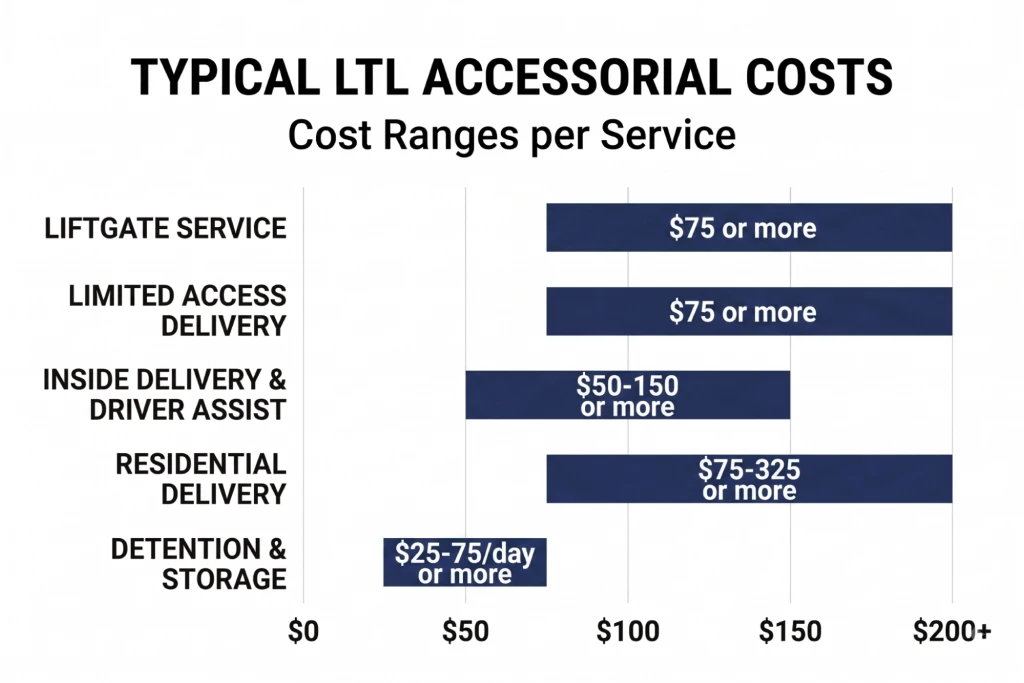
Image Source: Gemini 2026
Inside Delivery and Driver Assist
Standard freight delivery usually ends at the truck, dock, or curb. If the shipment must be moved inside a facility, or if the driver must assist with loading or unloading using a pallet jack, the carrier may apply an inside-delivery, driver-assist, or mechanical-unload accessorial fee.
Driver-assist charges often start around $50 and may reach $150 or more, while inside-delivery fees can be higher depending on the shipment, distance, building access, and carrier.
Residential Delivery
Shipping to a home or a business operating from a residential property may trigger a residential delivery surcharge. For LTL freight in Canada, these fees often start around $75 to $100, may reach $150 to $325 or more, and vary by carrier, shipment weight, and location.
Detention and Storage
Detention fees apply when a driver arrives on schedule but has to wait to load or unload, so having your team ready avoidß unnecessary delays. If freight sits beyond the carrier’s free storage window, expect daily storage fees from roughly $35 to $75 per shipment per day, up to $200+ for extended storage.
Why LTL Freight Sees More Accessorial Fees Than Truckload
Full truckload shipments move directly from origin to destination with one carrier and no additional stops. LTL freight, by contrast, is consolidated with other shipments, transferred between trucks, and delivered to a wider range of locations, so accessorial charges make up a larger share of your total freight cost than they would for a full truckload.
Do Freight Class and Density Affect Accessorial Charges?
Yes, because freight class is set by density, how much a shipment weighs relative to the space it takes up, and carriers who measure a different density than what you declared will reclassify the shipment and bill a reclassification fee.
For example, kegs and cans with empty space between them often measure denser on paper than in the trailer, pushing the freight into a higher class and raising both the base rate and the reclassification risk.
Run your numbers through our freight density calculator before booking to catch mismatches before the carrier does.
How to Avoid Surprise Charges
Avoid additional charges and manage your LTL freight shipping costs by double-checking all data and preparing for potential roadblocks.
- Provide accurate weight, dimensions, and delivery location before booking.
- Confirm loading dock access and flag any limited-access sites in advance.
- Communicate your special equipment needs to your carrier early.
- Prepare your team to assist drivers to avoid detention fees.
Plan ahead, and the fees quoted upfront will almost always be lower than those added after delivery.
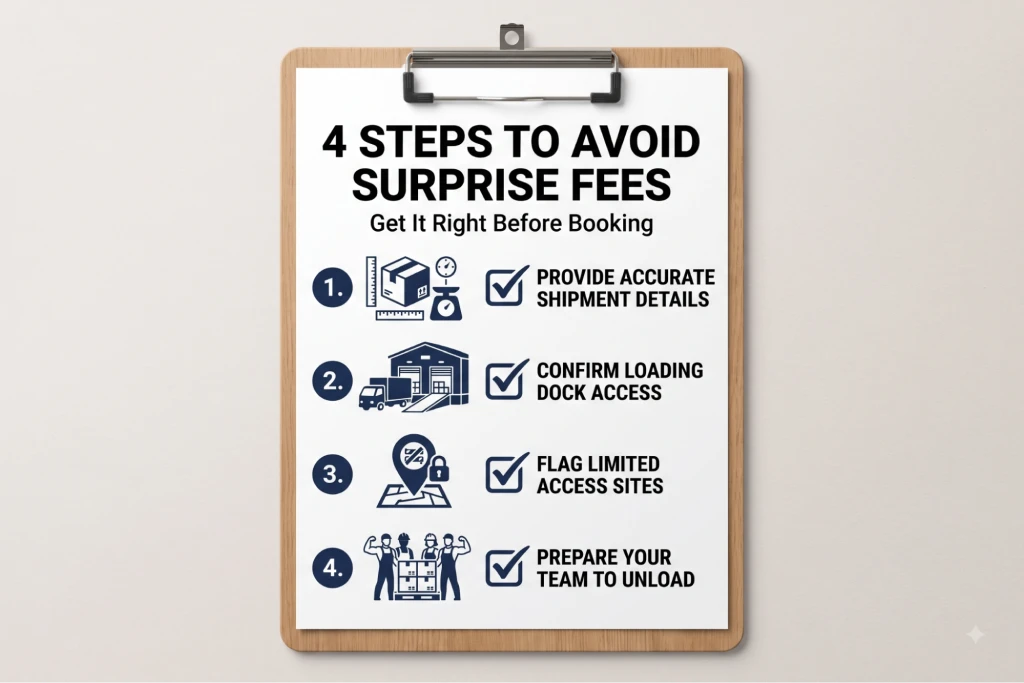
Image Source: Gemini 2026